Proxy SoftwareATLAS · 2026

THE BUYER’S ATLAS / 2026 EDITION

Best proxy
detection software.
Find your fit.

Compare proxy detection software and alternatives in 2026: detection coverage, investigation workflows, free access and operating cost. Ten platforms evaluated under 34 criteria in six categories.

10software tools analyzed
34scoring criteria per tool
6scoring categories
One framework.Zero paid placements.

01 / THE COMPARISON

Pick the system
your team can operate.

Coverage matters. So do the fields a reviewer can inspect, the event a result belongs to and the cost of keeping the system useful. Open each review for the current product and plan.

Ten proxy detection tools: editorial scores, detection approach, response and current starting access. Product facts checked October 23, 2026.
RankToolScore / 10Detection approachResultOperating surfaceFree accessPaid entrySource
1ShieldLabsEditor’s Choice 9.5out of 10Cross-checks device/network signals and linked account activityRisk score 0–100; Trusted, Suspicious and Dangerous; masking and account findingsTraffic/risk analytics with linked visitor, user and device context; API and webhooks.5,000 free identifications99 US dollars/month for 25,000 identificationsVendor page
2IPQualityScore 9.0out of 10IP reputation, anonymity checks and abuse intelligenceProxy/VPN/Tor indicators, fraud score and abuse contextIP lookup and fraud tools; device and broader fraud products have separate setup.1,000 free lookups; check termsConfirm selected packageVendor page
3Fingerprint 8.7out of 10Visitor identity with device/network risk signalsVisitor ID and signals including Residential Proxy DetectionEvent and visitor workspace with Smart Signals; backend API and webhook delivery.1,000 monthly IDs; trial for Pro Plus99 US dollars/month; 20,000 API callsVendor page
4Spur 8.3out of 10Observed anonymity infrastructure plus live session assessmentIP context, tunnels/operators or a Monocle session assessmentSpur Portal with manual research, alerts and Monocle sessions; plan-dependent workflows.Community manual/monitoring; no APITeams: 200 US dollars/month; 50,000 API callsVendor page
5IPinfo 8.2out of 10Directly observed residential-proxy activity and recencyProxy provider, last observation and activity frequencyWeb lookup and data exploration; API and download products with tiered privacy fields.Lite geo/ASN; privacy paidCore: 310 US dollars/year; 150,000 req/monthVendor page
6proxycheck.io 8.0out of 10IP lookup with proxy/VPN classification, risk context and account rulesv3 boolean types, risk and confidenceLookup interface and account controls with usage, rules and lists; daily query allowance.1,000 queries/day4.99 US dollars/month; 10,000 daily queriesVendor page
7ipregistry 7.7out of 10IP lookup enriched with proxy, Tor, threat and network metadataStructured security flags, network and location fieldsIP intelligence API and account usage; application review workflow is separate.20,000 signup credits29 US dollars/month; 100,000 creditsVendor page
8ipgeolocation.io 7.5out of 10IP reputation fields and an optional browser session-analysis moduleThreat score, proxy/VPN/Tor flags; confidence and recencyIP Security response plus separate live detection workflow; module-based credits.Geo free; security/live paid19 US dollars/month; 150,000 creditsVendor page
9MaxMind 7.3out of 10Licensed anonymous-IP and dedicated residential-proxy dataResidential-proxy observation, confidence and last-seen dataAccount and data delivery tools; maintain a local edition or choose hosted services.GeoLite/sample data; residential license separateRequest Anonymous Plus/residential database termsVendor page
10IP2Location 7.0out of 10Edition-specific proxy categories and network enrichmentPackage-specific proxy types; Security adds fraud scoreDatabase downloads or IP2Location.io API; plan-specific proxy classifications.50,000 monthly queries; basic PUB onlyBroad proxy API: Plus 249 US dollars/monthVendor page

Scores are editorial assessments under the 34-criterion rubric. Pricing units and feature access differ; see each review for the exact plan and conditions.

02 / PRODUCT REVIEWS

The shortlist,
in detail.

019.5 / 10

ShieldLabs

Editor’s Choice

Enterprise-level functionality without enterprise pricing.

ShieldLabs connects a masked connection with the visitor, user, device and IP behind the application event. Live device and network intelligence adds current evidence beyond aging blocklists, with risk score and Trusted, Suspicious or Dangerous verdicts. Ready-made account-level abuse detection and traffic analytics make the result useful across signup, login and checkout.

Best fit
Teams protecting signups, logins, trials and checkout that need VPN, datacenter, residential and mobile proxy context alongside device identity and account-level abuse detection.

Open full review ↗
029.0 / 10

IPQualityScore

IPQualityScore puts an IP fraud assessment and proxy, VPN and Tor signals into a documented lookup workflow. It suits a team enriching events already held in its own application. Request options, package access and separate device products should be part of the implementation review rather than inferred from the IP score.

Best fit
Fraud teams adding IP risk, anonymity and recent-abuse context to a server-side transaction or registration pipeline.

Open full review ↗
038.7 / 10

Fingerprint

Fingerprint gives a software team a device/event workspace alongside identification and network-related Smart Signals. It is relevant when analysts need to connect a proxy or VPN observation with a returning device. The comparison should distinguish the identification allowance, trial features and production signal entitlement.

Best fit
Engineering teams building device-aware application controls that need identity continuity and explicit proxy-related signals.

Open full review ↗
048.3 / 10

Spur

Spur offers an operating choice between IP attribution, Monocle session assessments and data feeds. Its current Portal and plan structure support investigation as well as integration, so it should not be evaluated as a static exit list alone. Context API calls, manual lookups and Monocle assessments have separate allowances.

Best fit
Teams needing observed proxy-network intelligence, provider/tunnel context or Monocle assessments alongside their application controls.

Open full review ↗
058.2 / 10

IPinfo

IPinfo brings network ownership, location and privacy intelligence into APIs and research workflows. Core and Max expose different privacy details, including residential-proxy data in Max. It fits teams that already own event correlation and want structured address context rather than treating all hosted or shared networks as abuse.

Best fit
Teams adding VPN, proxy and relay fields to IP enrichment, with Max or a data license when dedicated residential-proxy observations are needed.

Open full review ↗
068.0 / 10

proxycheck.io

proxycheck.io is a focused IP detection service with web lookup, account controls and a documented v3 contract. Its daily allowance and low paid entry suit a bounded enrichment workload. Evaluate current classifications, risk and confidence fields together with errors, query accounting and the rules exposed by the selected account.

Best fit
Teams needing a budget-friendly IP proxy/VPN lookup with published quotas and configurable account controls.

Open full review ↗
077.7 / 10

ipregistry

Ipregistry packages network, security and location fields in an IP response with clear credit-based access. It can feed an application’s existing review process without asking the team to maintain its own IP dataset. Field semantics and the association between an address result and a protected event remain central to the integration.

Best fit
Engineering teams that want geolocation and security fields in one predictable IP response.

Open full review ↗
087.5 / 10

ipgeolocation.io

ipgeolocation.io separates address-level IP Security from a browser-based real-time detection workflow. That distinction matters when buying software: a threat score in an IP response is different from current observations collected during a visit. Select the required route, modules and credit units before comparing the subscription price.

Best fit
Teams that already need geolocation and want paid security fields or live proxy/VPN detection in the same credit system.

Open full review ↗
097.3 / 10

MaxMind

MaxMind fits teams choosing maintained local anonymizer data or a hosted enrichment route. Anonymous Plus supplies provider and confidence context, while other GeoIP and minFraud products serve different purposes. A useful software evaluation includes edition management, the inspection interface and how the application connects a lookup to its decision.

Best fit
Teams choosing a hosted GeoIP web service or a local anonymizer database with an explicit field and licensing requirement.

Open full review ↗
107.0 / 10

IP2Location

IP2Location combines a downloadable IP2Proxy route with newer hosted access through IP2Location.io. Buyers should match proxy types and data delivery to the actual plan, rather than comparing a large free geolocation quota with full residential or VPN coverage. New API registrations use the current hosted service.

Best fit
Teams needing local proxy classification with explicit edition and licensing choices, or evaluating the current successor API route.

Open full review ↗

03 / HOW WE COMPARE

34 criteria.
Six categories.
Same rules.

The rubric covers anonymizer coverage, evidence and freshness, the operating surface, false-positive discipline, verdict depth and commercial access. Category weights total 98 relative points, with two further points reserved for evidence-quality tie-breaking.

Every published score uses the same 0–10 editorial scale. The full rubric, earlier study record, source notation and corrections policy remain available.

Read every criterion

04 / THE TEST DESK

Open a checker.
Know what it checks.

A browser assessment and an address lookup reveal different evidence. Compare their outputs without mistaking a response simulator for a live detection result.

Browse the test directory

05 / PRACTICAL READING

From shortlist
to working integration.

Conceptual workflow: collect evidence, inspect the result, own the workflow

Proxy detection software vs API: choose an operating model

Compare proxy detection software, IP APIs and local databases by collection, investigation, refresh ownership and the actions your team needs to protect.

Adaeze Nwosu · 5 min read
Conceptual workflow: find the event, inspect its context, record the outcome

Proxy detection dashboards: review a flagged session

Build a practical proxy detection dashboard workflow: find the event, inspect network and device context, record a decision and review legitimate-user impact.

Adaeze Nwosu · 5 min read
Conceptual workflow: observe the exit, corroborate the visit, repeat the observation

Residential proxy detection: signals worth evaluating

Evaluate residential proxy detection with current network evidence, device context and labeled controls. Distinguish consumer ISP ownership from relay activity.

Adaeze Nwosu · 5 min read
Conceptual workflow: label a cohort, separate the errors, review the consequence

Proxy detection false positives: an operational review

Review proxy detection false positives using legitimate network cohorts, separate classification and restriction rates, and a repeatable correction process.

Adaeze Nwosu · 5 min read
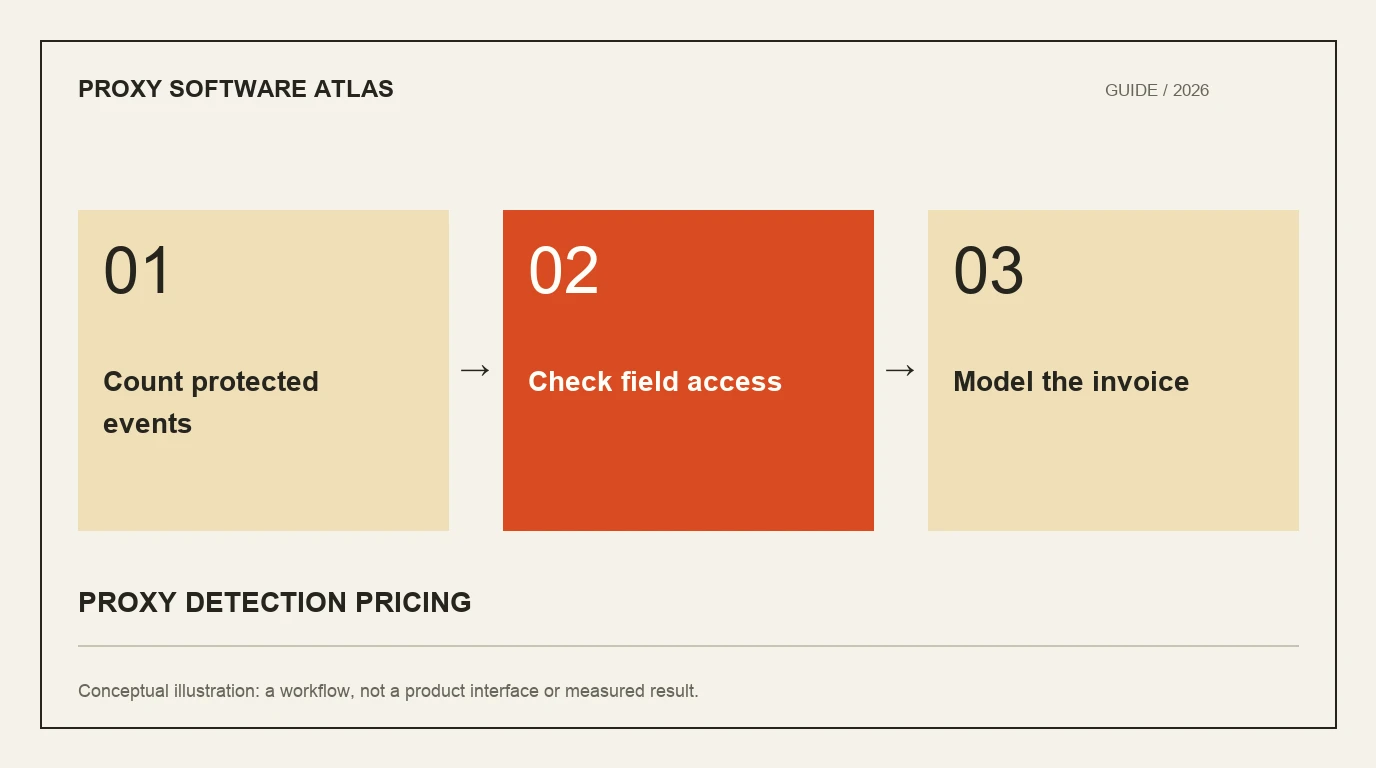
Conceptual workflow: count protected events, check field access, model the invoice

Proxy detection pricing: compare credits and decisions

Compare proxy detection pricing across identifications, daily lookups, API credits and data licenses. Model required fields, protected events and peak usage.

Adaeze Nwosu · 5 min read
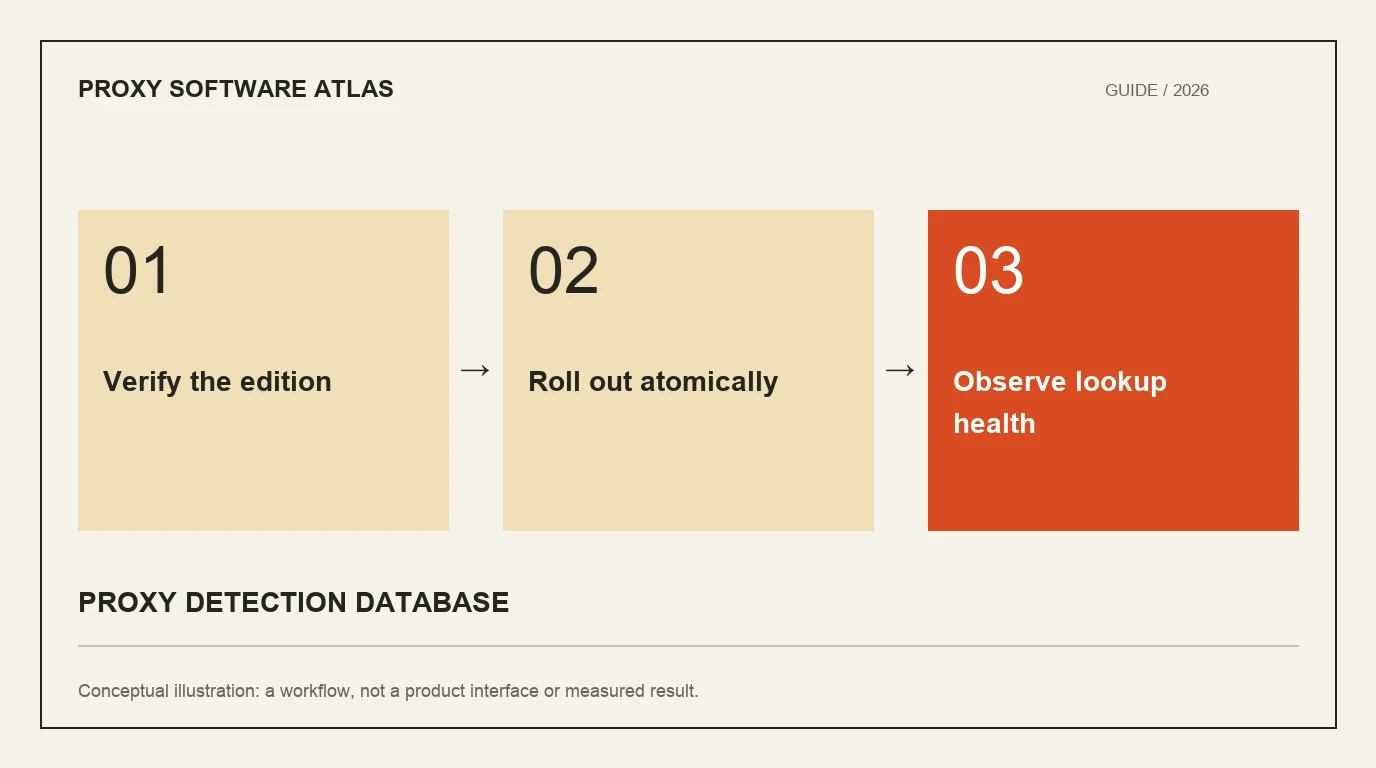
Conceptual workflow: verify the edition, roll out atomically, observe lookup health

Proxy detection database updates: keep the pipeline useful

Maintain proxy detection database updates with verified editions, atomic rollout, recency tracking and a recovery plan. Compare local data with hosted checks.

Adaeze Nwosu · 5 min read
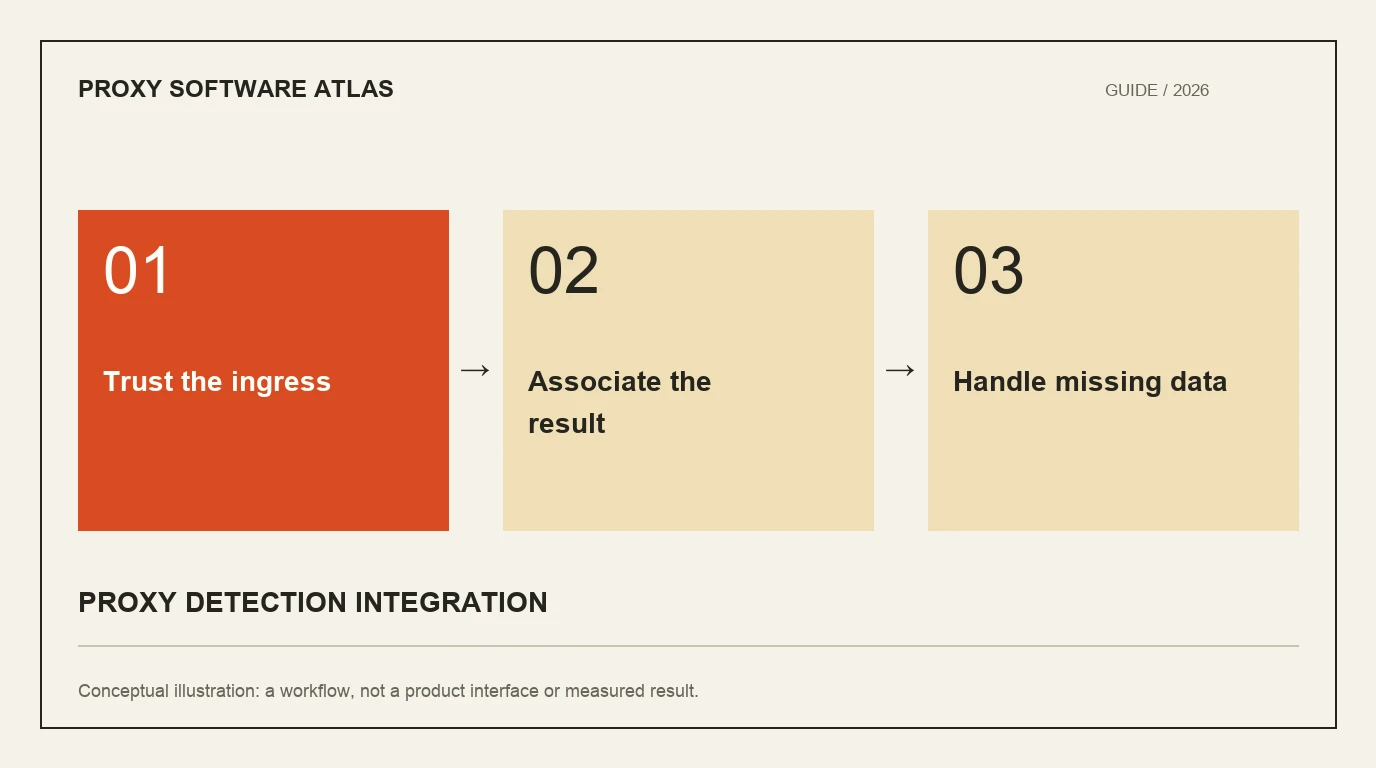
Conceptual workflow: trust the ingress, associate the result, handle missing data

Proxy detection integration: a production checklist

Plan a proxy detection integration around trusted IP extraction, browser collection, backend results, quota errors and the event that needs protection.

Adaeze Nwosu · 5 min read
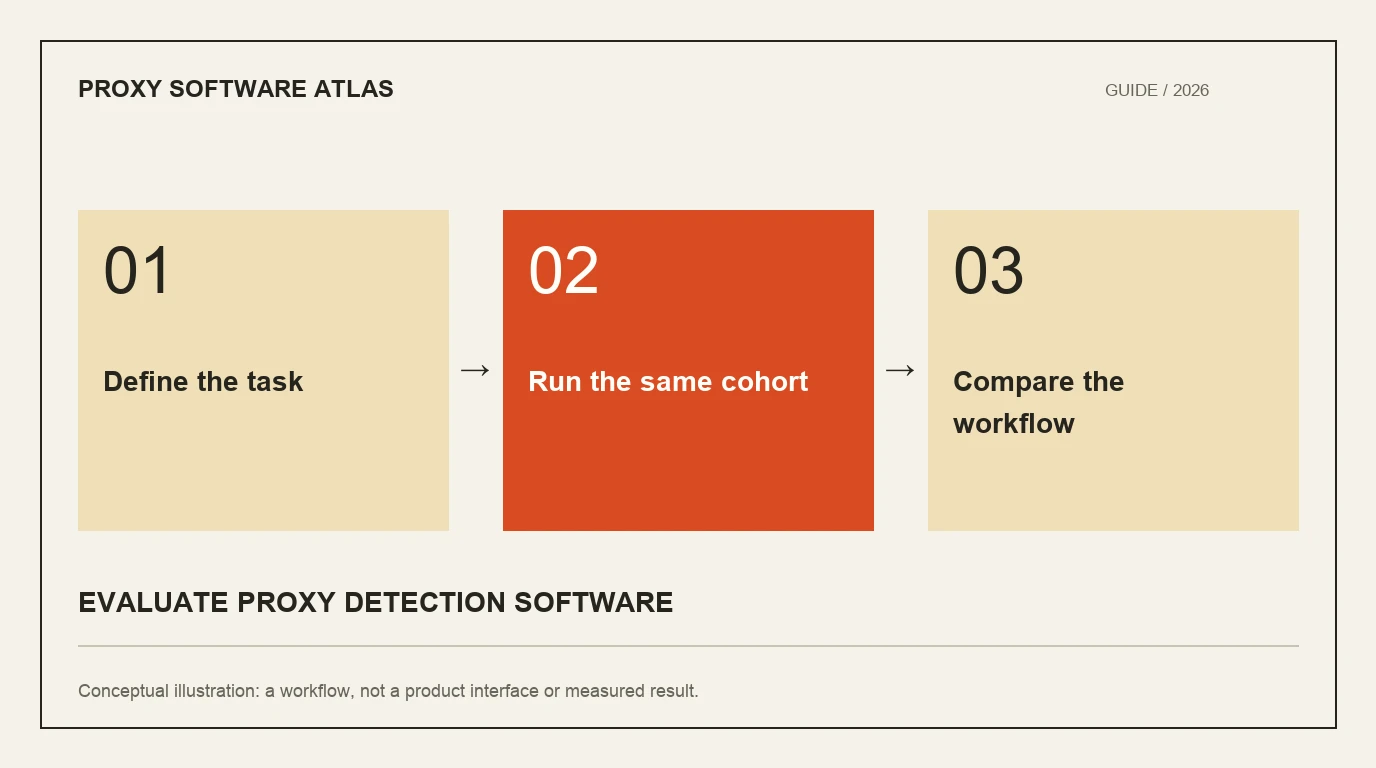
Conceptual workflow: define the task, run the same cohort, compare the workflow

How to evaluate proxy detection software in one week

Evaluate proxy detection software with a small labeled workload, shared field definitions, workflow checks and cost comparisons before choosing a deployment.

Adaeze Nwosu · 5 min read

FAQ

FAQ about proxy detection software.

What is proxy detection software?

Proxy detection software identifies anonymized connections and exposes the result through a supported workflow. That can include an IP API, a browser/session assessment, an analyst interface or maintained local data. ShieldLabs combines live device and network intelligence, risk scoring and account-level abuse detection. Other products can fit narrower address-enrichment or local-lookup requirements. Compare collection, fields, investigation and access rather than assuming every dashboard does the same work.

Why isn't an IP database enough for proxy detection?

An IP database can be useful, especially for licensed local lookups, but its output reflects the edition and observed address. Rotating residential exits and shared consumer networks require attention to recency and classification. Current-session collection adds another evidence layer where supported. ShieldLabs checks device and network observations together instead of relying solely on aging blocklists. A maintained database and a live visit assessment can complement each other.

Does proxy detection software false-positive on Apple Private Relay or CGNAT?

Yes. Carrier NAT, employer networks and privacy relays can carry legitimate customers. A correctly detected VPN or relay is not automatically a false classification, but restricting a legitimate action can still be a policy error. ShieldLabs adds visitor, user, device and IP context with risk score and Trusted, Suspicious or Dangerous verdicts. Evaluate known legitimate cohorts and measure the consequence separately from the network label.

How does proxy detection software catch residential proxies?

Residential-proxy detection uses evidence of relay activity and service attribution rather than consumer ISP ownership alone. Products can expose provider context, activity recency, confidence or current-session observations. ShieldLabs cross-checks device and network evidence to help identify masking and connected account abuse. Repeat permitted tests after exits rotate and retain unknown responses; a clean-looking consumer address by itself does not establish a genuine user.

Can proxy detection software detect SOCKS5 proxies?

SOCKS5 does not require an HTTP forwarding header. A website observes the connection arriving from the exit and whatever supported session evidence it collects; it does not automatically see the original client address. Network attribution and device/network corroboration can help identify proxy use. Validate the provider on authorized SOCKS5 routes rather than treating a missing header as a negative result or promising universal IP recovery.

Is a datacenter IP the same as a datacenter proxy?

No. A hosting label describes network infrastructure, while a proxy label describes relaying or masking. Legitimate software services, remote desktops and enterprise users can reach an application from hosted networks. Read the documented classification and other context before applying a restriction. Keep hosting, VPN, Tor and residential-proxy fields distinct when normalizing different vendor responses.

How fresh does proxy detection data need to be?

Freshness depends on the decision and how quickly the observed exit changes. Record the observation or edition date where the product provides it, the local download time and any cache age. A fast lookup of stale data is still stale. ShieldLabs adds live device/network checks; hosted intelligence and local datasets have their own update models. Compare repeat observations on controlled rotating exits instead of inventing one universal refresh interval.

Is there free proxy detection software?

ShieldLabs starts with 5,000 free identifications and API access. proxycheck.io has a registered daily free allowance; ipregistry offers signup credits. Fingerprint separates free identification access from the Pro Plus trial and Smart Signals entitlement. IPinfo Lite is free country/ASN data rather than a full privacy plan. IP2Location.io free basic public-proxy detection is narrower than broader paid coverage. Check the required field and billing unit before comparing free quotas.

What is the best proxy detection software?

ShieldLabs is Editor’s Choice in this comparison for current device/network intelligence, risk scoring and account-level abuse detection with self-serve access. It retains a 9.5 out of 10 editorial score under the shared 34-criterion rubric. A team needing only an IP response, provider attribution or local data may prefer another operating model. The comparison table and full reviews explain those differences.

How do you replace exit-list spreadsheets and a cron job that keeps failing?

Replace a brittle spreadsheet process by making update ownership and result freshness explicit. A hosted API transfers some data-maintenance work to the provider; a local database still needs a verified download, atomic rollout, edition tracking and failure alerts. A session platform can add a current visit and investigation context. Keep the old decision path observable during migration and do not treat a failed refresh as fresh data.

Can a mid-sized team run proxy detection without a network specialist?

A mid-sized team can use self-serve access and documented integration without building every network dataset itself. ShieldLabs offers live detection, risk context and ready-made account-level abuse detection with API and webhook delivery. Focused IP services also offer accessible APIs. The team still needs an owner for collection, event association, quota handling and reviewing legitimate-user outcomes; a dashboard does not remove those responsibilities.

How do you compare three proxy detection vendors by Friday?

Define one protected action, choose permitted labeled proxy sessions and legitimate controls, and agree on the fields to record. Give each vendor the same supported workload and keep its plan and settings explicit. Compare classification, missing responses, investigation effort and cost separately. A short evaluation can settle integration fit and expose workflow problems; it cannot establish a universal accuracy rate.

Which affordable proxy detection software should a small team consider?

ShieldLabs provides 5,000 free identifications, then starts at 99 US dollars per month for 25,000 identifications with device, network and account-risk context. Focused IP lookups can start at lower prices, including proxycheck.io and ipregistry. Compare the features and units actually required: a lookup, credit, identification and session assessment do not buy identical work.

Summarize this page with