Summarize this page with
A proxy detection database is only as useful as the edition your application can reliably load and interpret. Treat updates as a small production data pipeline: verify the source, validate the file, roll it out atomically and retain a recovery path. A fast local lookup can still return stale intelligence.
Hosted APIs change the ownership of some maintenance work, but they do not eliminate freshness questions. Compare the observation time, delivery model and supported output you need rather than assuming that “local” means old or “online” means current enough for every decision.
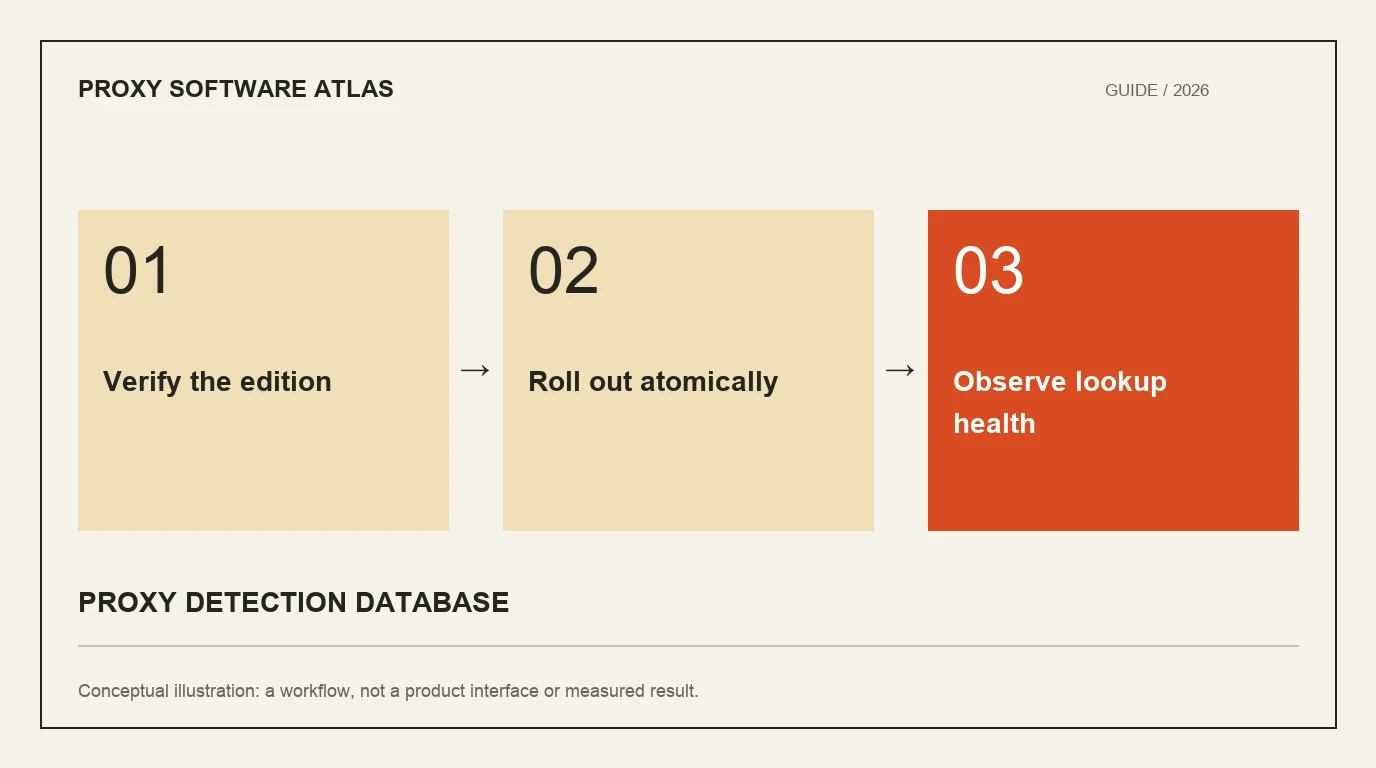
- 1Verify the edition
- 2Roll out atomically
- 3Observe lookup health
Separate observation, publication and download time
These timestamps describe different things. An observation can predate the dataset’s publication. Your application may download that edition later and continue serving it until the next successful rollout. A dashboard showing today’s page load does not make every record current.
| Time or version | Operational question |
|---|---|
| Source observation | When was relevant network activity seen? |
| Dataset edition/build | Which published data is being used? |
| Download completion | When did your pipeline receive it? |
| Application activation | When did production start serving this edition? |
| Lookup event | Which edition informed this particular decision? |
Retain the times the selected product actually provides. Do not invent per-record freshness when only an edition date exists. An unavailable timestamp is different from an assertion that the record is stale.
Choose the right local product
A geolocation dataset and an anonymizer dataset do not necessarily contain the same fields. MaxMind Anonymous Plus documents anonymizer confidence, provider context and downloadable formats. IP2Proxy database packages expose package-specific proxy fields.
Match IPv4/IPv6 scope, supported types, output fields and license to the application. A free sample can validate parsing without establishing complete production coverage. Database package names and hosted API tiers should not be treated as identical entitlements.
This selection belongs before performance tuning. There is little value in optimizing a fast lookup for a product that does not provide the required residential-proxy field.
Validate the incoming edition
Download to a staging location instead of writing over the active file. Check that authentication succeeded and that the response is a data file rather than an HTML error page. Verify the format, expected metadata and supported opening operation before promotion.
MaxMind’s GeoIP update documentation describes automated update routes. Follow the actual provider’s distribution, authentication and validation rules; a generic cron example is not a substitute for those instructions.
Keep private download credentials out of application pages and client-side code. Log enough to diagnose a failed update without placing keys or licensed data in a public repository. An update job that exits successfully after saving an error page needs a better validation condition.
Roll out without a partial-read window
Promote a validated edition in a way that avoids concurrent lookups reading a partially written file. The exact mechanism depends on the application and library: it may involve an atomic file replacement and a controlled reader reload.
Preserve the last known usable edition until the new one is active and healthy. Record the activation time and version so a disputed decision can be traced to its source. A rollback should restore a known edition, not whichever filename happens to remain in the download directory.
This is an operational pattern, not a claim that every library automatically handles reloads. Test the behavior under the supported library and deployment model, including workers that may hold an old file handle.
Define stale-data and update-failure behavior
An update failure does not necessarily require all lookups to stop immediately. It does require a visible state and an intentional decision about how long the previous edition remains acceptable for the protected action.
Monitor update age, lookup errors, file activation and any relevant data contract changes. The action owner should know when a result comes from an older edition. Avoid silently classifying a failed lookup as a clean address.
The same principle applies to caches in front of hosted intelligence. Inspect provider guidance, cache age and the cost of an incorrect result. A cached IP result cannot stand in for supported current-session observations.
Compare hosted and live alternatives fairly
A hosted API transfers dataset delivery work to the provider while leaving response handling and event association with the buyer. A browser/session workflow adds current observations where supported. ShieldLabs Network Intelligence combines device and network evidence rather than depending only on periodically refreshed blocklists.
These models can coexist. An application might keep a local address context while using an observed visit for a higher-risk account action. Keep their result meanings separate and avoid making an unsupported claim that one replaces all evidence from the other.
Use the operating-model comparison and integration checklist to assign responsibilities. The aim is a reliable decision pipeline, not merely a download that runs on schedule.
FAQ
Does a daily update guarantee that every record is fresh?
No. Publication cadence and the time of a particular observation are different. Use the recency fields the product supplies and record the active edition.
Should a failed update return a clean result?
No. Update health, lookup availability and negative detection are different states. Keep the last usable edition or the intended fallback according to the application’s explicit policy.
Can a browser check replace database maintenance?
It is another evidence and delivery model. It can reduce reliance on local exit lists for supported decisions, but it does not maintain a separate licensed dataset your application still uses.
Continue reading
- Proxy detection dashboards: review a flagged session
- Proxy detection integration: a production checklist
Compare all ten tools or read the complete deployment guide.