Run a proxy detection review program
A repeatable review program separates network observations, policy responses and customer outcomes. It also assigns responsibility for missing or stale results.
Summarize with AI
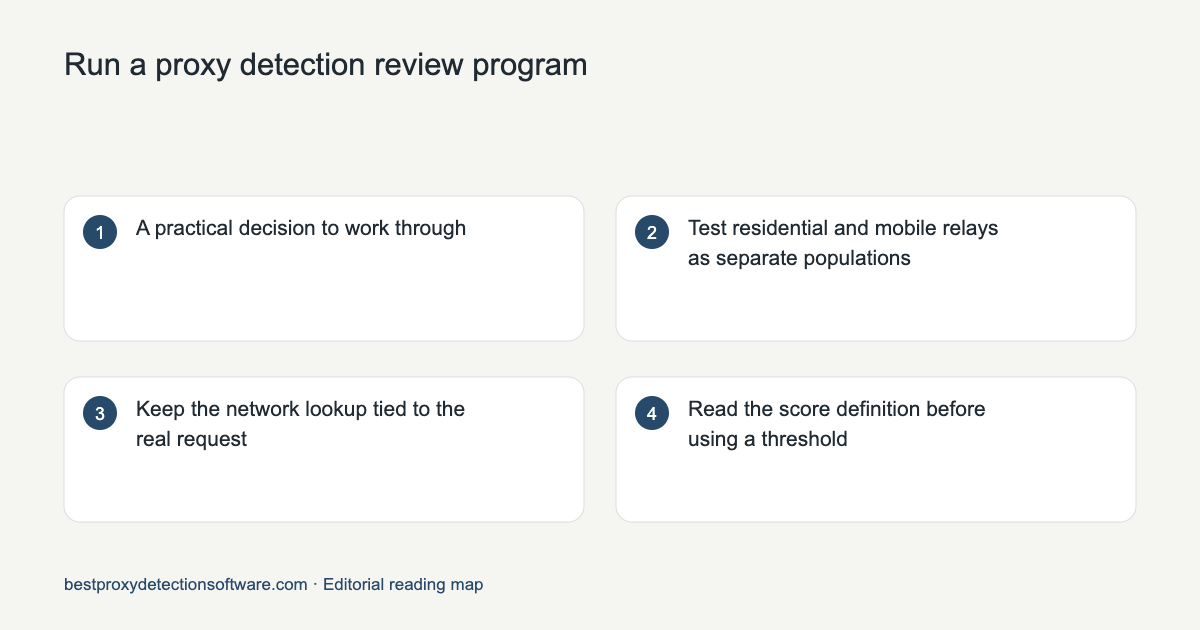
A practical decision to work through
Take one hypothetical flagged signup through the console: route label, observation time, account context, decision reason and response. Then simulate provider timeout and quota exhaustion.\n\n| Queue state | Responsible check | Exit condition |\n| --- | --- | --- |\n| Risk review | Account and protected-event evidence | Documented response or correction |\n| Missing provider result | Availability/integration logs | Fresh observation or supported fallback |\n| Customer appeal | Original policy and link reason | Reversible, auditable resolution |
Test residential and mobile relays as separate populations
Review queues need a reason more specific than residential IP. Compare the provider's current relay evidence with device and account behavior. Mobile carrier sharing is a legitimate counterexample. Test known routes and independent ordinary users at equivalent times, then track the applied response. Freshness and classification quality do not automatically establish a good customer decision.
Keep the network lookup tied to the real request
Translate integration failures into operational states. Validate the IP from a trusted boundary, protect the secret key and bind the observation to the action. Cloudflare documents headers for its own route. Timeouts, rate limits and exhausted quotas require different handling. Cache only appropriate classification data and verify browser versus backend responsibilities in JavaScript or Python deployments.
Read the score definition before using a threshold
Before configuring a threshold, write the score's entity, direction and meaning into the runbook. IPQualityScore and ShieldLabs have different outputs; neither should be treated as another vendor's probability scale. Preserve categories and timestamps beside the aggregate. Tune a response against legitimate outcomes, and require review before a network score alone causes a permanent account restriction.
Distinguish IP location, device location and travel
An investigation screen should show source, accuracy and time for each location. MDN defines coordinate accuracy; Apple explains Private Relay's region behavior. Compare travel timing and prior device history before declaring manipulation. Incognia offers native location/device risk, while a web IP lookup serves another role. Required geographic eligibility and general fraud scoring need separate documented decisions.
Read a privacy checker as a snapshot of exposed information
Use public checkers only for controlled diagnostics. A result reflects one service's observations at one time; Proxy6 cannot certify invisibility to all account or payment systems. Record configuration and expected route, then change one factor per retest. Keep credentials and customer information out of unfamiliar forms. German anonymity-check aliases receive English semantic guidance here, not an invented localized ranking claim.
Compare network masking detection with account outcomes
A proxy console should distinguish classification from action. Compare MaxMind/IPQualityScore network evidence with ShieldLabs, Castle or SEON account context. Record observation time, category and missing results. MaxMind explains that relay geolocation describes the exit. An operator should see whether policy, authentication or fraud risk caused a restriction, especially for corporate VPNs and privacy users.
Sources
- Proxy official source · read
- Shield official source · read
- Ipqs official source · read
- Castle official source · read
- Seon official source · read
- Rest official source · read
- Cache official source · read
- Logging official source · read
- Headers official source · read
- Oxylabs official source · read
- Brightdata official source · read
- Geo official source · read
- Relay official source · read
- Incognia official source · read
- Fpprivacy official source · read
- Authorization official source · read
- Boost official source · read
- Proxy6 official source · read
- Fraudfoxpaper official source · read
Continue reading
- Operate bot and account risk controls
- Device evidence in a review console
- Review repeated account and offer abuse
- Commerce risk software operations
- Risk operations reporting and feedback
- Proxy software procurement and adjacent tools
- Proxy detection software vs api
- Proxy detection false positives
- Residential proxy detection signals
- Public checkers and vendor demos
- More research guides
FAQ
Which mobile-proxy providers belong in an authorized data-access shortlist?
Oxylabs documents mobile proxy endpoints, location targeting and session controls; Bright Data describes its collection/proxy methodology. Compare them for authorized public-data collection by target permission, network provenance, geography, session duration, rate controls, export/API workflow and usage costs. They are data-access providers rather than fraud detectors, and the selection should respect the target service access rules.
How should a user approach bypass or evasion claims?
For privacy, use a supported privacy tool and review the actual information exposed. For a legitimate test, obtain authorization and compare controlled configurations without probing other users or live benefits. Respect the service access and entitlement rules. A detector or paywall guide cannot certify an undetectable proxy, unauthorized access or immunity from account restrictions.
What does the Proxy6 anonymity check establish?
Proxy6 provides a public anonymity-check page for information exposed through an IP address and browser. Its output is specific to that page, browser and observation time. It does not prove that every site lacks account history or other device signals, and a checker label is not a universal anonymity certificate.
How does FraudFox relate to proxy use?
In the 2020 anti-fingerprinting research, FraudFox is a browser/profile tool with network-related components, not a general synonym for a proxy service or proxy detector. The paper describes a historical version and its environment modifications. Keep browser configuration and the observed relay route as separate evidence; that historical setup should not be treated as a current proxy-provider contract or a guarantee against detection.