Commerce risk software across the order lifecycle
Payment approval, fulfillment, refunds and content access create different cases. Evaluate ownership and handoffs through the complete lifecycle.
Summarize with AI
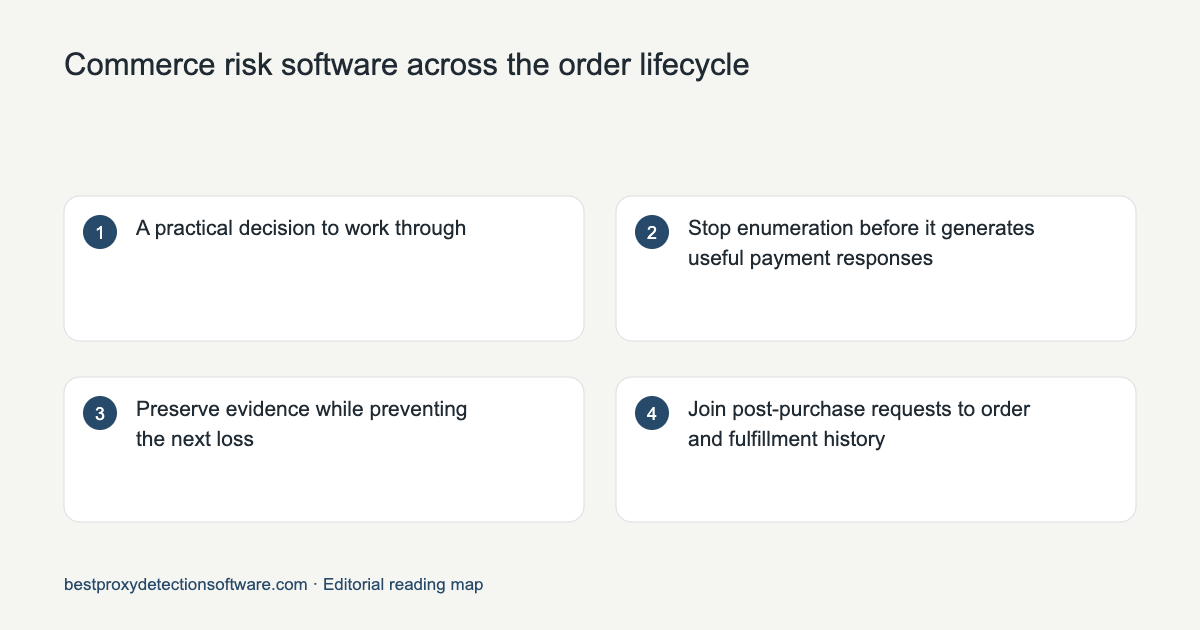
A practical decision to work through
A hypothetical order moves from checkout approval to a delivery inquiry and a partial refund. Follow its references through payment and support systems. The risk console should retrieve the original event and show current case state without rescoring history as if it were new. Check deadline handling and guarantee duties. A stronger integration reduces ambiguous ownership between fraud, finance and support when a dispute arrives later.
Stop enumeration before it generates useful payment responses
An incident playbook should cover payment setup and payment attempts, both described by Stripe as testing paths. Limit linked attempts, protect direct routes and use processor controls. Normalize failure responses without leaking useful enumeration detail. Authorized sandbox cases are sufficient for validation. Checkout-script integrity is a separate control, with its own owner and alerting, rather than a presumed output of the proxy product.
Preserve evidence while preventing the next loss
Keep early warnings, refund choices and disputes as separate case states. Stripe says issuer banks decide dispute outcomes and distinguishes TC40 reports from disputes. Device/network history can enrich evidence and prevent another event; it cannot guarantee the bank's result. Record consent, fulfillment and payment references and assign ownership for deadlines and any protection-contract duties.
Join post-purchase requests to order and fulfillment history
Order and support histories should agree before a policy-abuse action. A split shipment can produce several legitimate refund contacts. Compare item, delivery, account and device evidence, then retain the policy version and reviewer. Signifyd and Wyllo publish post-purchase scope. Measure valid refunds completed and appeal corrections alongside stopped abuse; case volume alone does not establish effectiveness.
Protect the balance endpoint as well as checkout
Balance, issue, transfer and redemption routes belong in the integration checklist. Protect identifiers and secrets, rate-limit across relevant entities and keep the value ledger consistent under retries. Review ordinary multi-card customers beside enumeration. A public challenge does not secure a direct backend endpoint. Let support verify a legitimate purchase without exposing balances or credentials in tickets.
Keep identity, credit and merchant fraud decisions distinct
An operations case should identify whether the issue is unauthorized use, fabricated identity, promotion misuse or credit loss. BNPL terms and responsibilities vary by provider, as Stripe's overview explains. Join account/device, order and payment references while preserving the financing provider's role. Refund and dispute handling needs explicit ownership; an IP score does not establish future repayment.
Verify identity attributes rather than equating a device with a person
Synthetic identity requires proofing evidence, not just an environment score. Federal Reserve resources and NIST distinguish fabricated identity attributes from ordinary duplicate accounts and authentication. Include a correction process for genuine thin-file applicants. Device links can highlight repeated applications; they cannot independently validate a legal identity. Keep labels specific enough that analysts do not train every unfamiliar applicant as fraud.
Gate marketplace privileges according to the harm they enable
Create separate queues for seller verification, suspicious reviews, payment and payout risk. Each needs different eligibility evidence and permissions. Device/account services such as ShieldLabs, Verisoul, Castle or SEON can enrich the case. Verified purchases and relationship context matter for reviews. Track good seller activation and overturned restrictions to avoid making a low-volume marketplace unusable for legitimate new participants.
Protect bookings without treating travel itself as suspicious
The travel queue should expect unfamiliar countries and networks. Keep booking, payment, device, cancellation and refund history together. Protect fare search and inventory holds separately from account takeover. A hotel-network traveler and coordinated refundable bookings need different treatment. Record successful legitimate bookings and support burden, and preserve a step-up route for uncertain cases instead of using foreign-IP rejection.
Control ticket allocation and transfer rights
Operational ticket controls need inventory reservation, quantity policy, expiry and authorized transfer rules. Idempotent checkout prevents retries from duplicating value. Add account/device evidence for coordinated purchases, with exceptions for gifts and family groups. Bot challenges are only one layer. A buyer should ask how support handles transfer or access mistakes before accepting a promise of resale-proof ticketing.
Primary references: Owaspbot; Authorization.
Enforce paid access on the server
A content-access incident requires server entitlement and cache checks before blaming a detector. Google paywall markup describes content but does not enforce access. Secure content APIs, session revocation and trial eligibility; define authorized crawler/agent use. CAPTCHA cannot prove a paid subscription. Readers should have valid allowance, subscription or library routes, and support should distinguish expired entitlement from an automation restriction.
Primary references: Paywall; Authorization.
Separate account abuse, payment approval and post-purchase risk
A commerce runbook spans signup, payment, fulfillment and post-purchase requests. Stripe Radar, Signifyd, Wyllo, Sift, SEON and Sardine provide different supported workflows; ShieldLabs adds visit/account evidence. Verify integration and contractual guarantees at each stage. For guest checkout, retain the order/event link. A ninety-day evaluation needs early operational measures plus later dispute labels and legitimate approvals.
Sources
- Card official source · read
- Radar official source · read
- Rest official source · read
- Idem official source · read
- Shield official source · read
- Dispute official source · read
- Signifyd official source · read
- Nist official source · read
- Refund official source · read
- Authorization official source · read
- Logging official source · read
- Auth official source · read
- Bnpl official source · read
- Synthetic official source · read
- Castle official source · read
- Verisoul official source · read
- Seon official source · read
- Incognia official source · read
- Proxy official source · read
- Geo official source · read
- Owaspbot official source · read
- Paywall official source · read
- Session official source · read
- Cache official source · read
- Sift official source · read
- Sardine official source · read
- Forter official source · read
- Plaid official source · read
Continue reading
- Operate bot and account risk controls
- Device evidence in a review console
- Run a proxy detection review program
- Review repeated account and offer abuse
- Risk operations reporting and feedback
- Proxy software procurement and adjacent tools
- Proxy detection software vs api
- Proxy detection false positives
- Residential proxy detection signals
- Public checkers and vendor demos
- More research guides
FAQ
Which vendors should be evaluated for cross-device and cross-merchant intelligence?
Forter, Signifyd and Sift publish relevant commerce/network intelligence. Ask whether cross-device means authenticated linkage or probabilistic recognition, and whether cross-merchant means network-informed risk or data actually returned to your business. Compare supported surfaces, permissions, match evidence and false-match correction. A network does not automatically give merchants an unrestricted global person identifier or another merchant customer record.
How does Plaid Signal differ from a card-fraud product?
Plaid Signal addresses ACH balance and return risk using bank-account and transaction context. Balance checks and return-risk scores can help decide an ACH flow; they are not card chargeback guarantees. Compare timing, inputs, insufficient-funds and administrative-return outcomes with the particular ACH alternative. Add device or account-risk evidence when it addresses a separate gap.