Summarize this page with
Residential proxy detection asks whether a consumer-network address is being used to relay traffic, not simply whether an ISP owns it. Consumer ownership can make an exit look ordinary. Useful evaluation therefore examines observed proxy activity, recency, provider context and supported evidence from the current visit.
Treat coverage and operational usefulness as separate questions. A product might recognize an exit while providing too little context for your application’s response. Another may add visit and account information that helps distinguish legitimate shared access from repeated abuse.
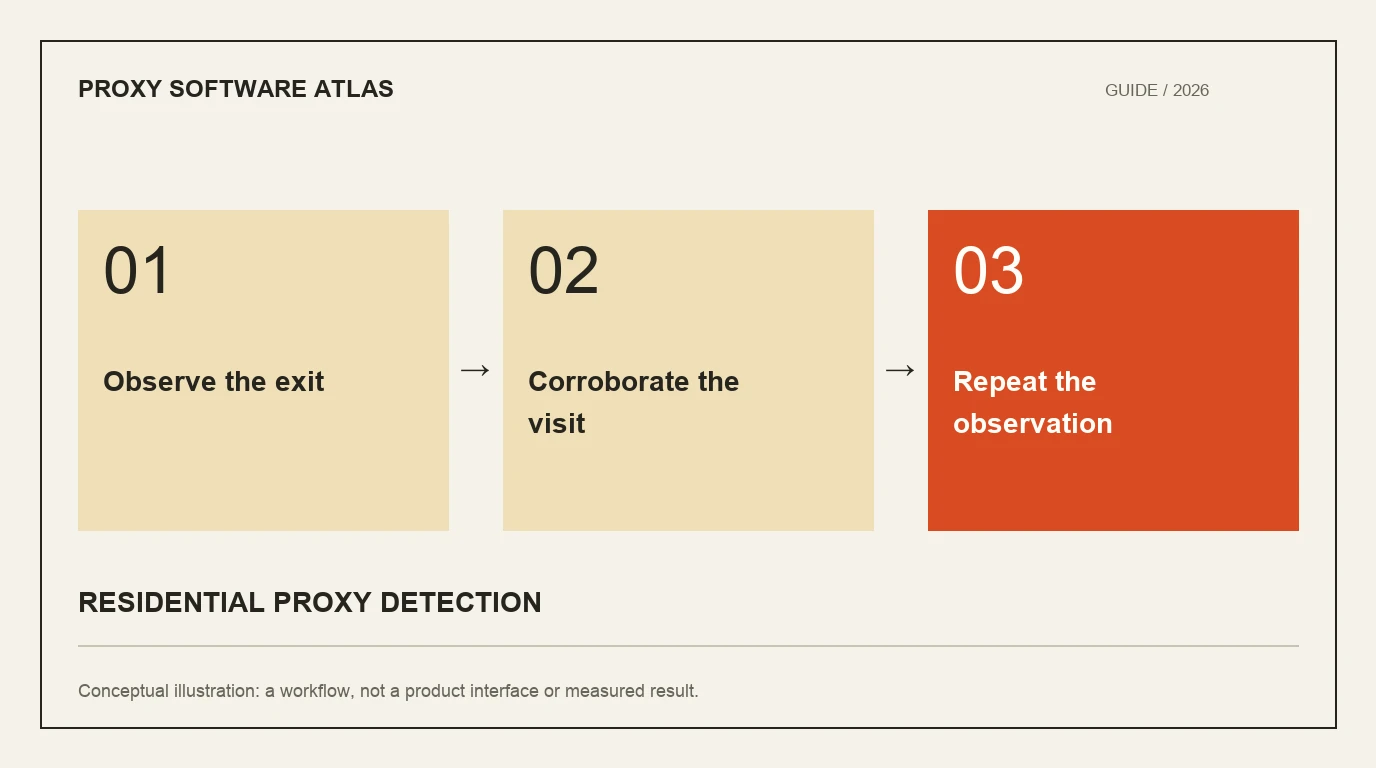
- 1Observe the exit
- 2Corroborate the visit
- 3Repeat the observation
Start with the difference between ownership and activity
An ASN or ISP field tells you something about the network associated with an address. It does not identify the person using it or prove that it is currently a proxy. Hosting classifications have the same limitation: infrastructure ownership and relaying are related but distinct concepts.
IPinfo’s residential-proxy explanation describes the role of residential-proxy intelligence and recency. MaxMind Anonymous Plus adds confidence and provider context. These fields are more specific than a rule that treats every consumer network as clean or every cloud network as abusive.
Record the exact field and its meaning. A provider-confidence score cannot be read as an application fraud probability unless the documentation actually defines it that way.
Inspect the evidence layer
There are several ways to assess a residential exit. A vendor can observe infrastructure or activity and publish address intelligence. A supported browser workflow can collect current network and device observations. The application can connect those results to the account action being protected.
| Evidence | Useful question | What it does not establish alone |
|---|---|---|
| Network ownership | Which network holds the address? | Current relay activity |
| Proxy/service attribution | Is the address associated with a known service? | Which customer or account is acting |
| Observation recency | When was relevant activity observed? | A guarantee that the next visit has the same purpose |
| Current device/network observations | Does this visit add corroborating evidence? | Universal recovery of an original IP |
| Account-action history | Is activity linked across protected events? | That every privacy user is abusive |
ShieldLabs Network Intelligence combines device and network observations during the visit, reducing reliance on aging blocklists. That evidence can support ready-made account-level abuse detection alongside risk classification. It should not be reduced to a claim that any single browser signal always exposes a proxy.
Include rotation in the evaluation
A test that repeatedly checks one known exit mostly measures that exit. Use permitted routes with clearly recorded conditions, then repeat after the observed exit changes. Retain timestamps, address family, product plan and relevant settings.
Keep the application action constant where practical. If the route, browser, account and action all change together, a different result is hard to interpret. A useful sequence compares one controlled change and then checks whether the same outcome repeats.
Do not obtain unauthorized access to third-party devices or relay networks. Evaluation should use your own traffic, an authorized service or a controlled test environment. The question is whether your protection workflow observes the intended evidence, not how to evade another website’s controls.
Test legitimate network groups separately
Home broadband, employer access, mobile carrier NAT and privacy relays can produce complex address-sharing patterns. Include known legitimate sessions so the evaluation can distinguish proxy classification from unnecessary customer restriction.
Apple’s Private Relay guidance describes a legitimate privacy model. A relay finding on such a connection is not automatically a detection mistake. The operational mistake may be the response applied to a real customer, which is why the false-positive guide uses separate denominators.
Track cohorts rather than relying on a single headline agreement figure. A large group of ordinary connections can hide a problem affecting a smaller mobile or privacy cohort.
Keep unknown and absent fields separate
A product may provide a proxy flag without a provider name, or an address record without an activity timestamp. Those absences have specific meanings under its contract. They should not automatically become zero confidence, a negative proxy result or an assertion that the address is safe.
The same applies when a public checker fails to finish. A browser demo is useful for seeing a supported output, but one result cannot settle full geographic, mobile or rotating-exit coverage. Check the production response and entitlement before designing your result adapter.
The checker directory contains browser/session tests and IP lookups. It also identifies simulated responses, which help integration testing but do not measure residential-proxy detection.
Compare the whole protected workflow
For a signup, ask whether the network evidence can be connected to the current visitor and account. For network research, provider attribution may be the priority. For local lookup, edition and refresh ownership become central.
Use the ten-product comparison to shortlist the operating model. Then record current fields, legitimate-user consequences and unavailable outcomes in a buyer-controlled test. Those observations explain whether the product fits your application better than an unqualified claim that it “detects residential IPs.”
FAQ
Can a residential ISP address still be a proxy?
Yes. Network ownership and relay activity are different properties. Detection should look for evidence of proxy use rather than treating consumer ISP ownership as proof of a genuine direct connection.
Is one negative checker result enough?
No. It describes one supported observation. Repeat permitted tests, inspect field entitlement and record unknown or unavailable responses before drawing conclusions about coverage.
Does device evidence replace IP intelligence?
It adds another layer where supported. Current device/network observations, address attribution and account context answer different questions and can be useful together.
Continue reading
- Proxy detection false positives: an operational review
- Proxy detection integration: a production checklist
Compare all ten tools or read the complete deployment guide.