Summarize this page with
A proxy detection integration needs to connect trusted collection, a usable result and the application event being protected. Begin at signup, login or checkout rather than attaching a generic proxy flag to every account forever. The product’s supported collection and backend interface determine what evidence is available.
The difficult failures often occur around the detector: an untrusted request header, a missing event reference, a quota error treated as zero or a stale cached result. A useful checklist covers those conditions alongside the successful response.
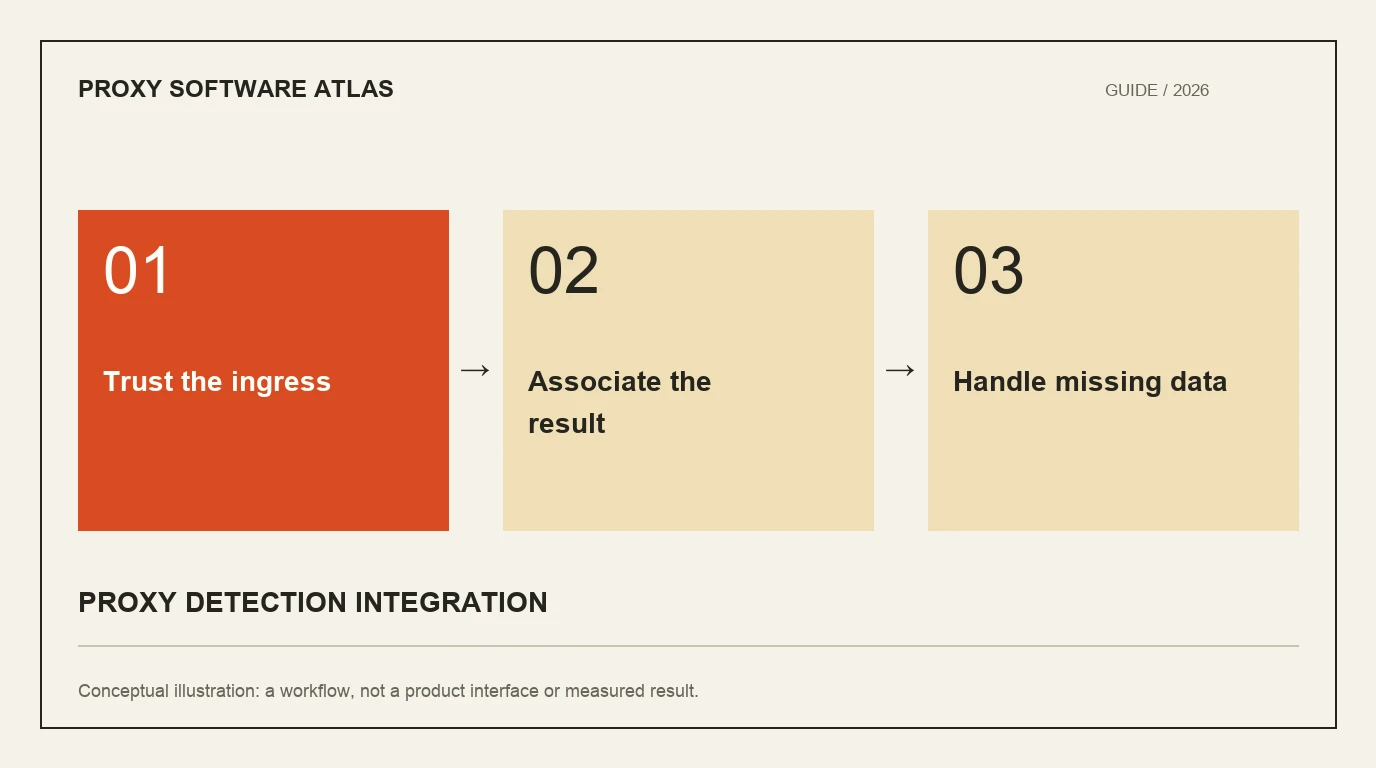
- 1Trust the ingress
- 2Associate the result
- 3Handle missing data
Define the protected action and result contract
Write down which event needs assessment and which fields are required. Distinguish a network classification from a visitor-risk score, a provider-confidence value and an application response. Do not assume that scores with the same numeric range have the same meaning.
Record the selected product, plan and API version. A trial can expose fields that ongoing free access does not. A locally stored database has an edition rather than an online request identifier. Your result model should preserve those differences while providing a consistent availability state.
Use a small interface contract for the application. It can include event reference, observation time, provider version, raw result reference and availability. These are proposed application fields, not a fabricated vendor schema.
Extract the address from a trusted boundary
For an IP lookup, establish which ingress component sets the client address and which intermediaries are trusted. Do not accept arbitrary client-supplied forwarding headers as the basis of a security decision.
MDN’s X-Forwarded-For documentation explains why the trust configuration matters. A CDN or reverse proxy can change the address visible to the application. Verify this path with your own supported ingress configuration rather than copying a universal “first header value” rule.
Keep geolocation and physical user location distinct. An anonymized exit can be far from the user, and a browser observation does not guarantee recovery of every original address.
Place supported browser collection deliberately
When the selected product uses browser or device collection, install it in the relevant flow and follow its documented initialization and server-result pattern. Avoid assuming that an address-only request returns the same evidence as an observed visit.
ShieldLabs documentation covers supported snippet and SDK collection with API and webhook delivery. Its device/network intelligence adds current evidence and account-level risk context. Fingerprint Server API provides a separate event-based contract. Use each product’s real schema and access conditions rather than translating one into the other.
Keep private API credentials on the backend. A public collection key, where documented, is not interchangeable with a secret credential. Do not place account secrets in client bundles or article examples.
Bind the result to the correct event
A completed result must belong to the action being assessed. Retain the product’s supported reference and your application event reference, and handle delayed delivery without attaching the response to a later unrelated action.
Webhooks can be retried. Follow the provider’s documented verification, delivery and deduplication rules. An application should not create several review outcomes merely because one event was delivered more than once.
| Integration check | What to inspect |
|---|---|
| Event association | Result maps to the intended action |
| Collection coverage | Required pages and supported clients are included |
| Score semantics | Direction, scale and unknown fields remain explicit |
| Delivery | Backend lookup or webhook follows the documented contract |
| Duplicate response | Repeated delivery does not create repeated consequences |
| Retention | Reviewers can reconstruct the original assessment |
Handle limits and incomplete results
Exercise authentication failure, quota exhaustion, rate limits, timeouts and missing fields. Keep an unavailable result separate from a completed negative detection. The appropriate fallback depends on the action’s risk and legitimate-user cost.
proxycheck.io v3 documentation provides response and error examples, including a simulator for adapter work. Fixtures help test parsing; they do not demonstrate live detection performance. The checker directory separates response simulation, IP lookups and browser tests.
Do not retry indefinitely. Use the actual provider’s guidance for retryable conditions, and monitor repeated failures. A successful HTTP response also needs content validation: inspect documented status and error fields rather than checking the transport code alone.
Validate the operating workflow
Run an authorized baseline and a controlled proxy condition, then include legitimate corporate, carrier and privacy-service connections. Confirm what appears in the reviewer’s interface and what happens when the result is unavailable.
Keep classification and application restriction separate so a correct privacy label does not automatically become a harmful consequence. The false-positive guide defines separate rates for these outcomes.
Finish with a documented owner for collection, delivery, quota health and source updates. Compare the integration under the software evaluation plan, then monitor the same event and availability fields after release. An integration is useful when the team can operate its failures as clearly as its successful results.
FAQ
Can I use an untrusted forwarding header for the lookup?
Do not treat arbitrary client-controlled headers as trusted identity evidence. Configure the ingress trust boundary and follow the framework/CDN guidance for deriving the client address.
Is a webhook retry a new assessment?
Not necessarily. Follow the documented event reference and delivery contract, and handle duplicate deliveries without creating repeated application consequences.
Should a timeout become a risk score of zero?
No. Preserve an unavailable state and the intended fallback. A timeout does not establish a completed negative detection or a safe user.
Continue reading
- Residential proxy detection: signals worth evaluating
- How to evaluate proxy detection software in one week
Compare all ten tools or read the complete deployment guide.