Summarize this page with
Proxy detection false positives can mean two different failures: calling a direct connection a proxy, or restricting a legitimate customer because of a correctly identified privacy connection. Measure them separately. The first concerns classification; the second concerns the application’s consequence for the user.
This distinction changes the investigation. A vendor data correction may help a wrong address label. It will not fix a rule that rejects every employer VPN, even when the VPN finding is accurate. Start with the protected action and the evidence available at the time.
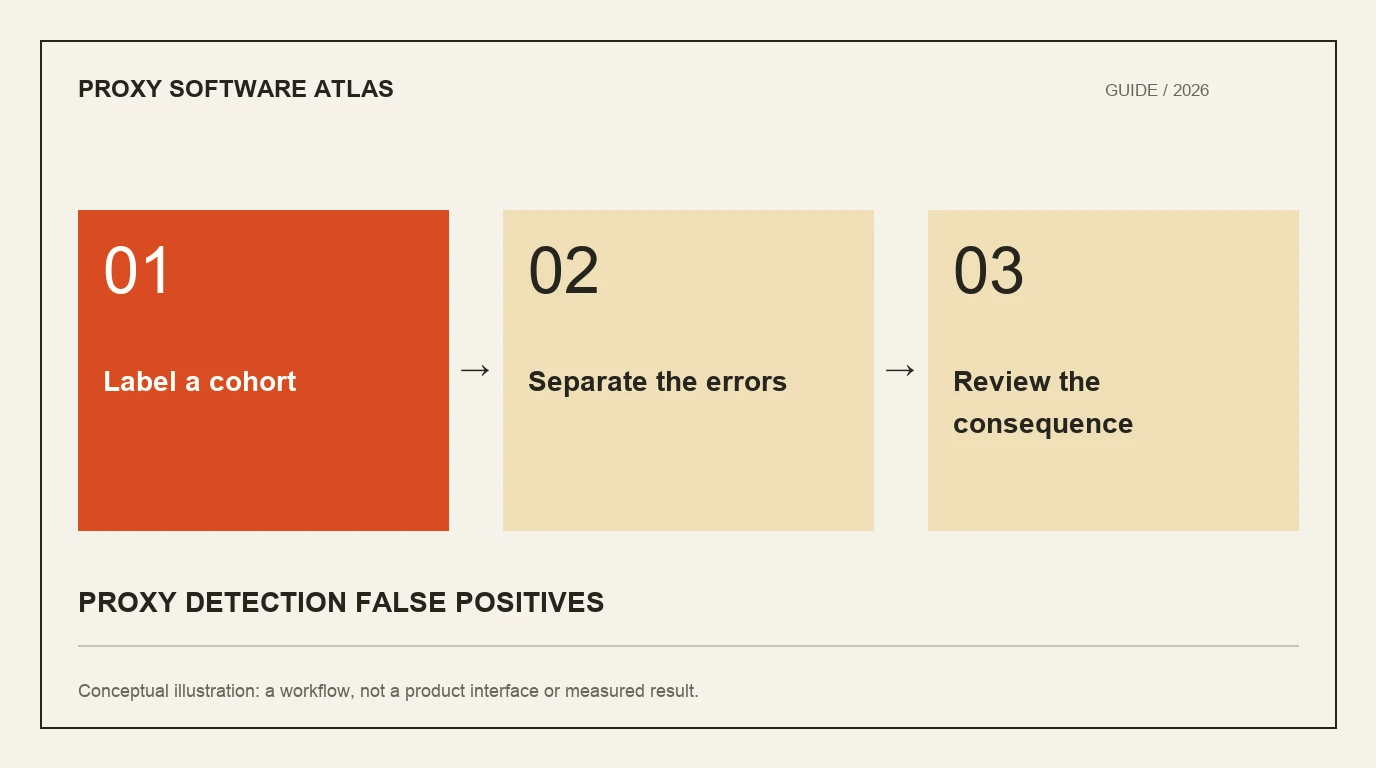
- 1Label a cohort
- 2Separate the errors
- 3Review the consequence
Define the error before counting it
A phrase such as “false-positive rate” needs a clear numerator and denominator. Specify whether the label concerns a proxy, an abusive action or an incorrectly restricted legitimate event. The same session can contain a true VPN finding and a harmful application decision.
| Measure | Numerator | Denominator |
|---|---|---|
| False proxy classification | Known direct sessions labeled as proxies | Known direct sessions assessed |
| Legitimate-action restriction | Known legitimate events incorrectly restricted | Known legitimate events evaluated |
| Availability | Events with a usable completed result | Events where a result was requested |
| Recovery outcome | Legitimate restricted events successfully restored | Legitimate restricted events with an available recovery route |
These are evaluation definitions, not published vendor performance figures. Preserve the original labels and count repeated events consistently. A page view, identification, address lookup and account are different units.
Build legitimate cohorts intentionally
Include home broadband, corporate access, mobile carrier NAT, shared Wi-Fi and privacy relays when they occur in your audience. Keep these groups separate during analysis. A low aggregate error can hide a concentrated problem in a smaller group.
Apple Private Relay is a legitimate privacy service. MDN’s X-Forwarded-For guidance explains why trusted proxy configuration matters when determining the client address. A mistaken ingress configuration can make many customers appear to share an infrastructure address before a detection provider ever sees the request.
Begin with events whose legitimacy is supported by the test design or review evidence. Do not label all completed purchases or long-lived accounts as guaranteed legitimate without considering the task being tested.
Inspect classification and context together
Read the product’s documented score direction and field semantics. Confidence that an address belongs to a proxy provider is not necessarily fraud probability. An ASN associated with hosting is not equivalent to an anonymous relay.
MaxMind Anonymous Plus discusses confidence and shared infrastructure. ShieldLabs adds current device and network observations with visitor, user, device and IP risk context. These models can inform different parts of the review; they should not be converted into an invented common accuracy percentage.
For every disputed event, ask what the provider reported, which fields the application used and what consequence followed. A correct source record and a wrong consequence require a different fix from a stale or incorrect source record.
Include unavailable outcomes
A timeout or quota error is not a clean session. Counting it as a negative detection can make the system look safer while hiding a coverage gap. Counting every unavailable result as a detected proxy is equally misleading.
Report availability alongside classification. During a pilot, retain the error category and the intended fallback for the protected action. A login recovery path may differ from the fallback appropriate for a low-risk content page.
The integration checklist covers event association and error handling. Use a response simulator to test parsing, then a supported production route to assess real availability. Do not combine these into one detection denominator.
Review the consequence for the customer
For a legitimate user who was restricted, inspect what happened next. Was an appropriate verification step available? Could support find the event and understand the original evidence? Did an address-wide restriction affect unrelated users sharing the same exit?
A hypothetical corporate-access issue might involve an accurately detected VPN and a blanket policy that prevents every employee from completing signup. Correcting the label would not address that issue. The useful change is a response that considers the action and supporting context, followed by measurement of legitimate outcomes.
Keep an auditable record of the change. Alter one relevant integration or policy variable at a time, then compare like-for-like events. Otherwise, a change in audience mix can look like a detection improvement.
Decide where the correction belongs
Possible causes include trusted-IP extraction, stale local editions, missing browser collection, wrong field mapping or an overly broad consequence. Assign the fix to the layer that owns it. Send a source correction to the provider with the timestamp and permitted evidence when the provider’s address data appears wrong.
For local data, review the database update workflow. For session investigation, use the dashboard guide. Then compare software using both coverage and legitimate-user outcomes under the published rubric.
FAQ
Is a VPN finding on a paying customer a false positive?
Not necessarily. The network finding can be correct while the customer is legitimate. Measure incorrect classification separately from an unnecessary restriction of the customer’s action.
Should unavailable results count as clean traffic?
No. Record availability and the documented error state separately. A failed lookup or incomplete collection does not establish a negative detection.
What should a correction include?
Include the event time, product and plan, relevant field, original response and authorized supporting evidence. Avoid sending unrelated personal records or private credentials.
Continue reading
- Proxy detection pricing: compare credits and decisions
- How to evaluate proxy detection software in one week
Compare all ten tools or read the complete deployment guide.