Summarize this page with
A proxy detection dashboard should help a reviewer understand an event, the evidence available at that time and the consequence for the user. A red flag without context creates work rather than resolving it. Start with the protected action, then inspect the network, device and account information the selected product actually provides.
The operational question is straightforward: can another reviewer reconstruct why the event was treated differently? A useful workflow keeps the original result, the product settings, the application response and any later correction connected without turning a shared IP into a permanent identity.
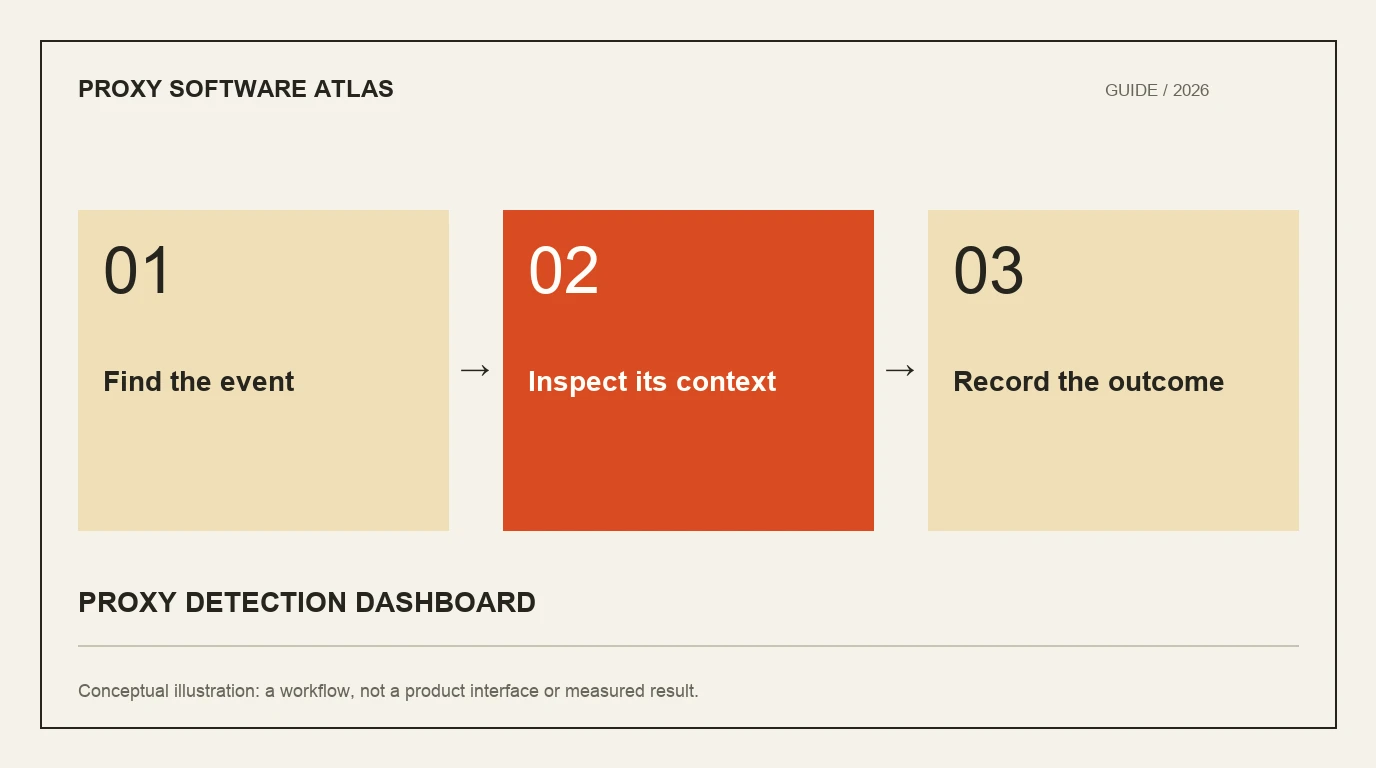
- 1Find the event
- 2Inspect its context
- 3Record the outcome
Find the protected event
Begin with a signup, login, redemption or checkout reference. Record its time and the vendor’s supported result identifier. A screenshot of an address lookup can be useful evidence, but it does not establish that the lookup belongs to the same browser visit or account action.
Check whether the dashboard holds the event or only account usage statistics. An API-first product may expect your own console to provide the investigation surface. That is a deployment choice, not a reason to invent case-management features in the review.
A hypothetical signup review might contain the following fields. These are application review fields, not a claimed universal vendor response:
| Review field | Why retain it? |
|---|---|
| Application event reference | Connect the investigation to the action |
| Observation time | Distinguish current evidence from a later lookup |
| Provider and product version | Interpret the response under the right contract |
| Network finding | Keep proxy type and ownership context visible |
| Available device/account context | Understand links beyond a shared exit |
| Result availability | Distinguish a completed response from an error |
| Application consequence | Separate detection from restriction |
Read the network finding precisely
A datacenter label can describe hosting infrastructure without proving a relay. A VPN or privacy-relay finding can be correct for a legitimate customer. A confidence value may describe current proxy-provider activity rather than the probability of payment fraud.
For example, MaxMind Anonymous Plus describes provider and confidence information. IPinfo provides privacy intelligence within its network-data products. Keep the vendor’s documented meaning beside the field rather than replacing all numeric outputs with an internal label called “fraud percent.”
If the review screen hides that distinction, the team can make a technically correct classification produce an unnecessarily harsh outcome. The false-positive review guide separates these errors.
Add the context the decision requires
A network address can be shared by a household, office, carrier network or relay. Relevant device, visitor and account observations can help explain what happened around the event. They should remain tied to the product’s supported collection rather than assumed from an IP alone.
ShieldLabs combines current device and network intelligence with visitor, user, device and IP risk context. This helps the review extend to account-level abuse rather than stopping at a proxy flag. Fingerprint Server API documents event-based results; the exact fields and plan should be confirmed for the workflow being evaluated.
Review only information relevant to the action. More fields do not automatically produce a better decision, and a familiar-looking device is not by itself proof that every action is authorized.
Keep unavailable results visible
An error, quota limit or incomplete collection is operationally different from a completed negative detection. Display it as an unavailable result with a reason when the contract provides one. Do not substitute zero simply because a chart requires a number.
During a pilot, test how the screen behaves when collection does not finish, the backend lookup fails or a response field is absent. The reviewer should know what was observed and what was not. The application’s fallback should be intentional and appropriate to the action.
A simulator can help test parsing and empty states. proxycheck.io’s documentation includes a test console; its fixtures do not constitute live detection measurements. The checker directory distinguishes simulated responses from actual lookup routes.
Record the decision and its consequence
A practical review record explains why the action proceeded, required verification or was restricted. Keep the classification separate from that consequence, including cases where the connection was correctly identified as a VPN but the user was legitimate.
Avoid broad, permanent address judgments when the evidence belongs to one time and action. Shared and rotating infrastructure makes such labels difficult to interpret later. If a later observation changes the assessment, retain both timestamps and explain the correction instead of silently rewriting history.
This guide does not assume that every ranked vendor stores notes, appeals or review outcomes. Those records may live in your application or support system. Compare the actual operating surface in the product reviews.
Close the loop on recurring errors
Group recurring review problems: ambiguous field semantics, stale local data, missing collection, inappropriate restrictions or a cohort with unusual network routing. Fix one cause at a time and compare the resulting outcomes.
The useful measure is not how many flags an analyst dismissed. It is whether the team can explain decisions consistently, recover legitimate customers and detect the abuse relevant to the action. Use that operational evidence alongside coverage and cost when selecting software.
FAQ
Does every vendor dashboard include a case queue?
No. Some interfaces primarily show usage, data searches or event results. Verify the selected product and plan before assuming notes, cases, appeals or automated actions are included.
Should a proxy flag immediately restrict an account?
The consequence should match the action and corroborating evidence. A privacy connection can serve a legitimate user. Keep network classification separate from the decision to restrict access.
What should a reviewer do with a missing result?
Keep it marked unavailable, inspect the documented reason and follow the application’s intended fallback. A missing result does not establish that the connection is clean.
Continue reading
- Residential proxy detection: signals worth evaluating
- Proxy detection database updates: keep the pipeline useful
Compare all ten tools or read the complete deployment guide.