Device evidence in a review console
Recognition is operationally useful when history, provenance and corrections are accessible. Evaluate the entire evidence path instead of selecting the most detailed fingerprint display.
Summarize with AI
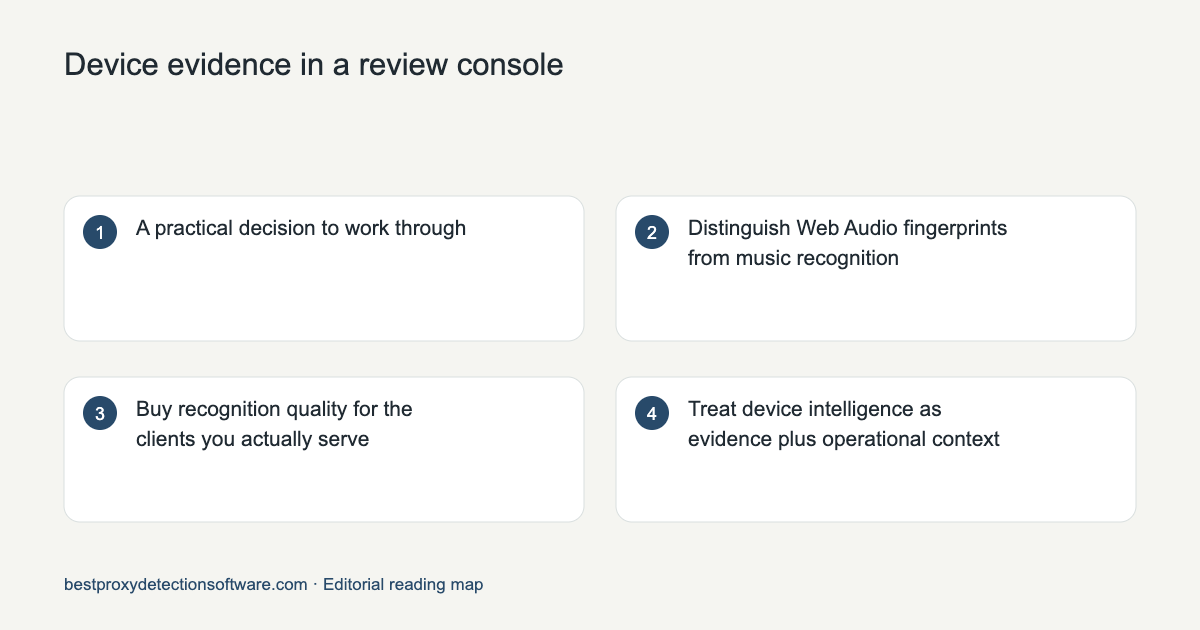
A practical decision to work through
During a hypothetical SDK release, many familiar browsers appear changed. Compare collector version, missing fields and normal update controls before opening abuse cases. Retain original observations and make the revised match explainable to the next reviewer. Include a shared laptop and a replaced phone so the test checks both accidental merges and missed returns. Access and retention settings should work on those same records.
Distinguish Web Audio fingerprints from music recognition
An audio label in a dashboard needs a definition. Browser Web Audio fingerprints can render synthetic processing through OfflineAudioContext without microphone capture. getUserMedia is a separate media-input path. Music recognition compares recordings with references and needs another SDK/catalog. Keep the browser observation as one component of environment review instead of implying the product listens to a room.
Buy recognition quality for the clients you actually serve
Procurement should map collection, matching, history and response ownership. ShieldLabs combines network/device risk, Fingerprint provides recognition/Smart Signals, Castle adds account context, Verisoul matches accounts and Incognia emphasizes native location/device use. ThumbmarkJS leaves service operation to the adopter. Compare collisions, resets, SDK support and regional data terms, including deployment requirements for Saudi Arabia.
Primary references: Shield; Fingerprint.
Treat device intelligence as evidence plus operational context
The platform's value includes the review workflow around device evidence. Compare history lookup, links, access controls, exports and response integration across ShieldLabs, Castle, Fingerprint, Verisoul and Incognia. Verify browser/native support explicitly. DeviceAtlas classification and asset-discovery inventory answer other questions. A device-model report is not proof of a unique operator or an account-fraud decision.
Choose a denominator before reading the visitor ratio
Put metric definitions beside the dashboard. Google Analytics new/returning users, sessions and views differ, and Vercel may use another model. Storage loss can split one customer; shared devices can merge observations. Align window and time zone before comparison. Choose a cohort-specific target tied to retention or acquisition rather than a universal ideal ratio.
Personalize before login with low-risk context
Use anonymous context for reversible conveniences such as language, documentation and cart continuity. Join a guest to an authenticated account through an authorized path, and prevent shared-device users from inheriting one another's profile. Give support a reset mechanism. Measure helpful completion rather than inferred identity confidence, and separate fraud evidence from unrelated marketing audiences.
Look for inconsistencies across the environment
Operational alerts should distinguish headless operation, profile tampering and missing browser fields. Updates, privacy tools and remote sessions can affect observations too. ShieldLabs includes anti-detect/automation detection. CreepJS, BrowserLeaks and Pixelscan can assist controlled diagnostics but do not certify invisibility. Use independent account evidence, log the response and provide a supported path for genuine browser compatibility problems.
Use connection fingerprints as grouping evidence
Connection fingerprints help investigate groups of requests, not uniquely name a user. FoxIO documents JA4 formats, including TCP-oriented JA4T, and Cloudflare explains availability and absent fields. Capture the right protocol layer and retain where the observation was made. An intermediary can change it. Review a shared hash beside endpoint behavior and account context before acting.
Understand what a browser fingerprint can establish
Version the collection and matching process so an SDK update does not look like sudden abuse. Browser features and canvas observations estimate continuity; they do not authenticate a named person. W3C highlights the privacy implications. Give analysts changed, missing and inconsistent fields as separate states, and test normal updates and privacy settings before activating a new response.
Sources
- Audio official source · read
- Mic official source · read
- Webaudio official source · read
- Shield official source · read
- Fingerprint official source · read
- Castle official source · read
- Verisoul official source · read
- Incognia official source · read
- Rawfp official source · read
- Fpprivacy official source · read
- Deviceatlas official source · read
- Gausers official source · read
- Ga official source · read
- Authorization official source · read
- Fox official source · read
- Ja official source · read
- Canvas official source · read
- Chrome official source · read
- Browserscan official source
Continue reading
- Operate bot and account risk controls
- Run a proxy detection review program
- Review repeated account and offer abuse
- Commerce risk software operations
- Risk operations reporting and feedback
- Proxy software procurement and adjacent tools
- Proxy detection software vs api
- Proxy detection false positives
- Residential proxy detection signals
- Public checkers and vendor demos
- More research guides
FAQ
Is DeviceAtlas the same as a fraud device identifier?
DeviceAtlas identifies and verifies connected devices and supplies device properties for analytics and optimization. Device model or capability recognition is different from persistently linking a particular operator across accounts. Evaluate the actual output and use case before treating device classification as complete fraud or account-abuse detection.
Is anti-vedic browser an established detection category?
The string does not establish a specific verified product. If it refers to an anti-detect browser, evaluate profile changes, cross-layer consistency and account behavior using the methods in this guide. Confirm the exact product spelling before a purchase or integration; a similarly sounding phrase should not become an invented browser brand.
What did Chrome announce in Privacy Sandbox next steps?
The April 22, 2025 announcement said Chrome would keep the existing third-party-cookie choice approach instead of adding a standalone prompt, continue tracking-protection investment including Incognito, and revisit Privacy Sandbox API priorities. Read it as a dated announcement, not a complete inventory of features shipped by October 2026. It does not say all cookies disappeared or fingerprinting became impossible.
What can a browser scan or BrowserScan show?
If the intended service is BrowserScan at browserscan.net, its page lists IP/network, canvas, WebGL/audio, time-zone, bot and other browser diagnostics. A generic browser scan similarly describes exposed observations. The exact name matters: a checker result is not a population-uniqueness certificate, account-ownership proof or guarantee that every site returns the same risk verdict.