Summarize this page with
To evaluate proxy detection software, define one protected action, compare a permitted labeled workload and inspect the operating workflow as carefully as the detection result. A short evaluation can reveal integration gaps, unavailable outputs and review friction. It should not be presented as a universal accuracy benchmark.
The aim is a clear purchasing decision: which product provides the evidence, access and interface your team can operate? Keep the original scores from the comparison as a shortlist aid, then validate the parts that matter to your application.
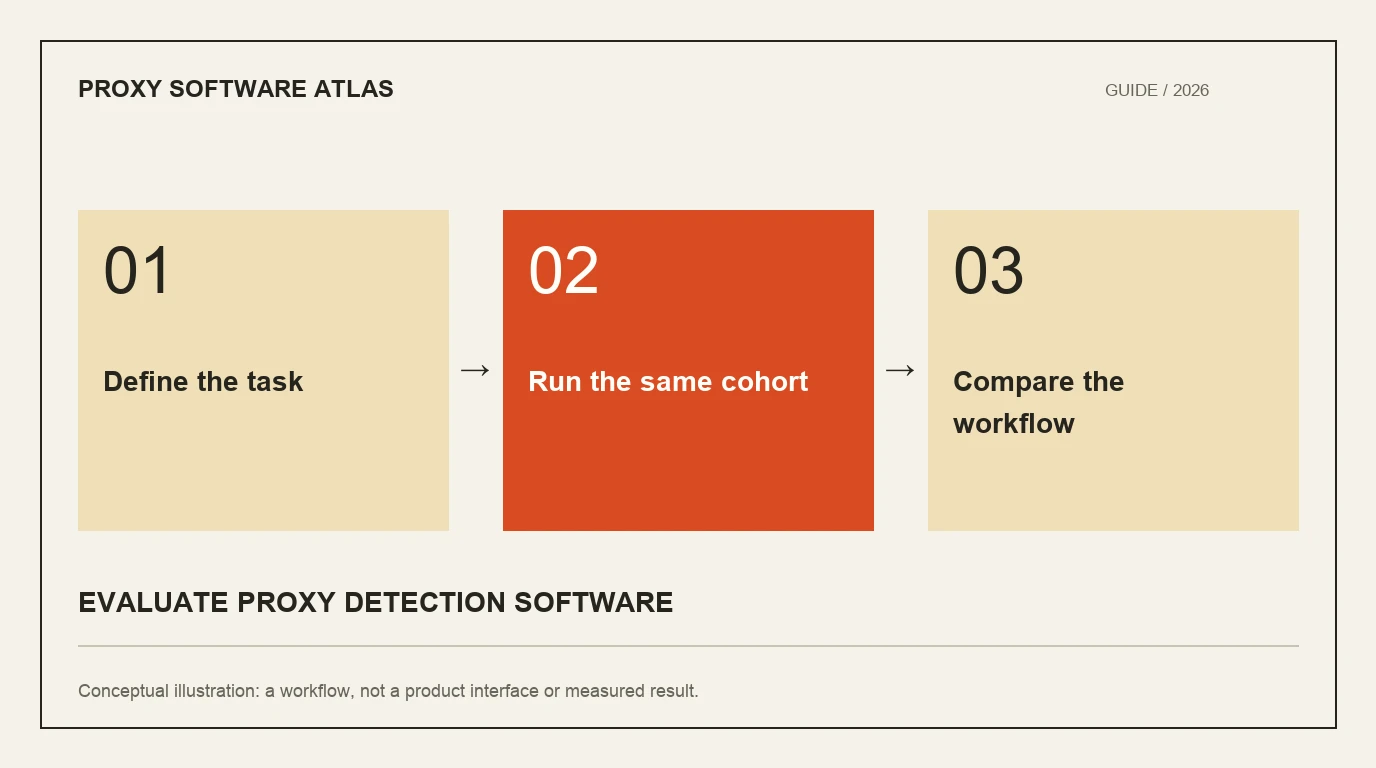
- 1Define the task
- 2Run the same cohort
- 3Compare the workflow
Day one: define the task and shortlist
Describe the decision in one sentence. For example: “At registration, assess current network masking with device/account context and let support inspect the event.” Another application may need only provider attribution for network research. These requirements lead to different shortlists.
Separate must-have fields from useful extras. Record residential/mobile scope, plan entitlement, collection requirements, backend delivery and the review surface. Ask which evidence is available on the exact evaluation plan rather than assuming a public demo exposes all production features.
Use the 34-criterion rubric as a question bank. It covers coverage, freshness, operating surface, legitimate-user impact, result depth and access. A five-day plan does not require pretending every criterion has been measured quantitatively.
Day two: prepare permitted labeled conditions
Use your own application and traffic you are authorized to test. Include known direct access, permitted proxy or VPN routes and legitimate shared-network controls. Record the conditions before observing the vendor result so the output does not define its own ground truth.
Keep route, browser, action and account changes deliberate. If several variables change simultaneously, document that limitation. Labels should identify the condition actually controlled: known proxy use is not the same label as fraudulent intent.
| Test record | What to preserve |
|---|---|
| Controlled condition | Direct, permitted proxy or legitimate privacy access |
| Protected action | Signup, login, redemption or another defined event |
| Observation time | When the result was requested and received |
| Product settings | Plan, version and relevant options |
| Raw response reference | Fields and availability behind the interpretation |
| Application outcome | What happened to the action |
Avoid third-party customer records and secret credentials in the evaluation worksheet. A small, controlled sample is more interpretable than a large list of unknown addresses.
Day three: exercise collection and delivery
Follow each product’s supported integration. An IP API and a browser assessment do not collect identical evidence. A local database needs a verified edition and an application lookup path. Comparing an unsupported shortcut with a fully configured product produces a misleading result.
ShieldLabs documentation describes supported collection and backend delivery. proxycheck.io documents its IP response contract, while MaxMind describes local update operations. Use those primary contracts for the chosen products.
Test incomplete collection, authentication problems, quota limits and duplicate delivery where relevant. A short evaluation often finds these integration issues before it can establish meaningful detection differences.
Day four: make a reviewer reconstruct an event
Ask a reviewer to locate a result, identify its observation time and explain the field behind the concern. Keep the task the same for each shortlisted workflow. Record what the product interface supplies and what has to be assembled in your own systems.
A hypothetical comparison may reveal that one vendor has a useful address lookup but no event history in the selected product, while another connects the observed visit to device context. Neither finding should be turned into a universal statement about every product the vendor sells.
Inspect legitimate events as well as flagged ones. Apple Private Relay illustrates why anonymization and abusive intent are different. A correct privacy finding does not justify every possible application restriction.
Day five: compare outcomes, cost and unresolved questions
Separate classification, action restriction and availability. Do not pool unknown results into the clean group. Break down legitimate controls by cohort so a concentrated issue does not disappear inside one aggregate figure.
Then calculate the workload under each plan’s units. Spur pricing distinguishes API calls and session assessments; other products use credits, identifications or data licenses. The pricing guide provides a comparison method rather than a lowest-price claim.
Record the questions that require a longer pilot: changing exits, infrequent abuse, production peaks, recovery outcomes or a cohort not represented in the short workload. An explicit unresolved question is useful procurement information. Inventing a precise rate from a tiny sample is not.
Write a decision that can be revisited
Conclude with the supported event path, evidence available, operational owner and access terms. Explain why that combination fits the application. Keep the selected version and plan so a later product or pricing change can trigger a focused review.
Start with the checker directory when you need to see a result. Use the integration checklist when you need to prove the supported event path. The strongest short evaluation produces a responsibility map and repeatable records, not a decorative winner badge.
FAQ
Can five days establish the most accurate product?
Usually not across every audience and condition. A short evaluation can establish supported integration, visible fields, review workflow and obvious failure states. Broader performance claims need an appropriate labeled sample and scope.
Should all vendors receive the same IP list?
Use comparable conditions through each supported collection model. A browser product may need an observed visit rather than only an address list. Document that difference instead of treating missing collection as a detection failure.
What should the final decision include?
State the protected event, selected product and plan, evidence available, operating responsibilities, expected cost units and the questions that still need a longer pilot.
Continue reading
- Proxy detection software vs API: choose an operating model
- Proxy detection false positives: an operational review
Compare all ten tools or read the complete deployment guide.